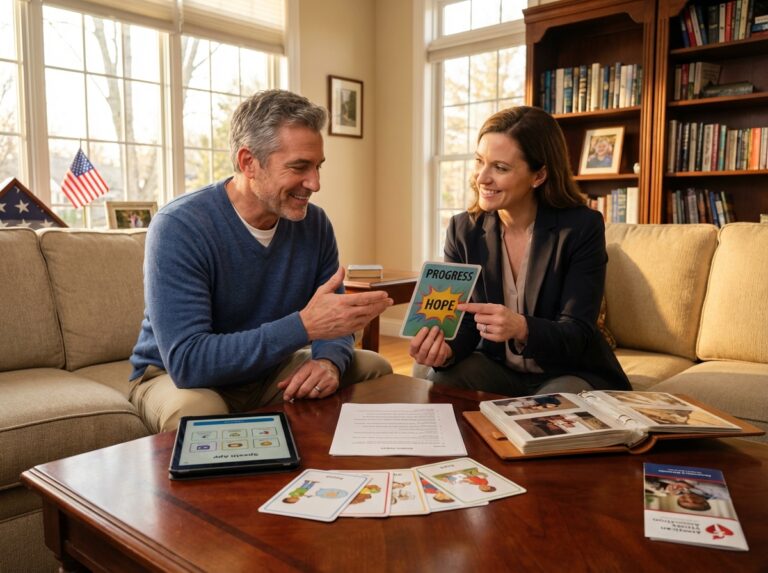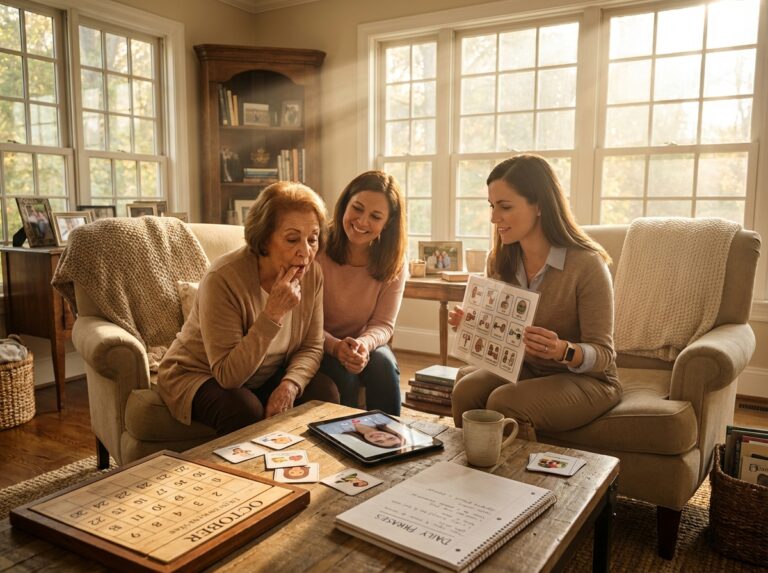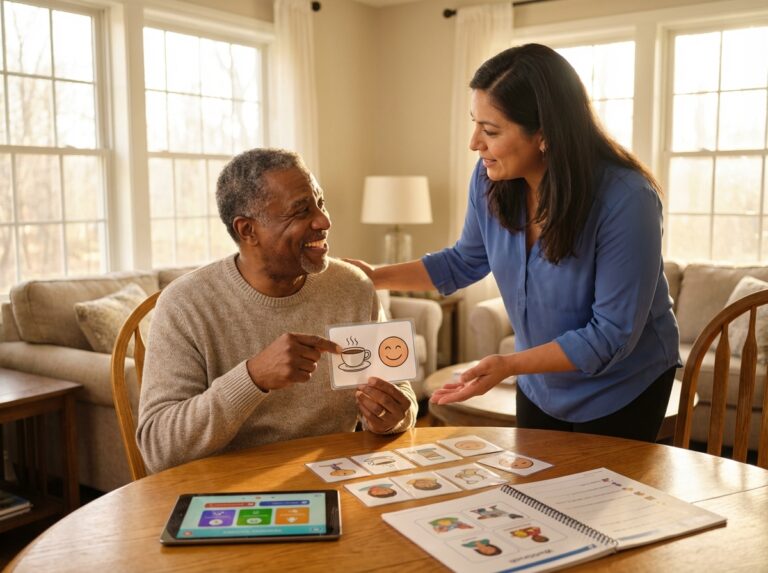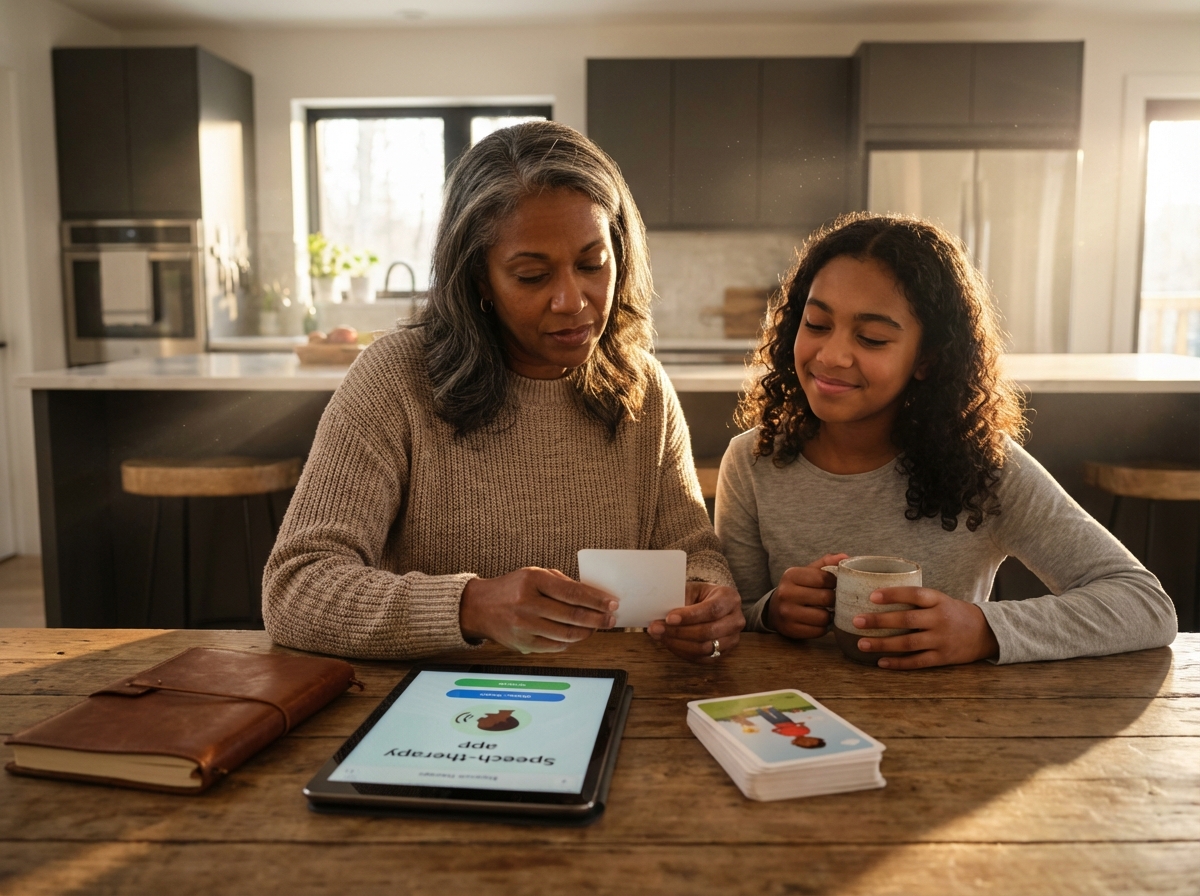
After stroke or brain injury, aphasia changes how people speak, understand, read, and write. This practical guide helps families build safe, evidence-informed home practice routines that boost communication, memory, and connection. It outlines how to assess strengths, set goals with an SLP, use step-by-step activities for different severity levels, and monitor progress to keep practice meaningful and sustainable.
What is Aphasia and How It Shows Up in Daily Life
Aphasia is a language disorder that changes how a person processes words. It usually happens after a stroke or a head injury. It is important to know that aphasia is not a loss of intelligence. The person still has their thoughts and memories. They just have trouble getting those thoughts out or taking in what others say. According to the National Aphasia Association, about 2 million people in the United States live with this condition. The brain is a complex network. When a specific area gets damaged, the “wires” for language get tangled.
Understanding the Main Types of Aphasia
Expressive and Receptive Differences
There are two main categories that help families understand what is happening. Expressive aphasia makes it hard to speak or write. The person knows what they want to say but cannot find the words. Receptive aphasia makes it hard to understand spoken or written language. It is like hearing a foreign language that you used to know but can no longer translate. Most people have a mix of both types.
Broca Aphasia
This is often called non-fluent aphasia. Speech is slow and takes a lot of effort. A person might say “Walk dog” instead of “I am taking the dog for a walk.” They often leave out small words like “the” or “is.” It can be very frustrating because the person is usually aware of their mistakes.
Wernicke Aphasia
This is a fluent aphasia. Speech sounds smooth and fast, but the words do not make sense. They might use made-up words or jargon. A person with Wernicke aphasia often does not realize that others cannot understand them. They might also have significant trouble understanding what you say to them.
Global and Anomic Aphasia
Global aphasia is the most severe form. It affects almost all parts of communication. A person may only be able to say a few words or sounds. Anomic aphasia is milder. The main problem is finding the right names for objects or people. They might describe an object instead of naming it, such as saying “the thing you use to open the door” instead of “key.”
How Aphasia Shows Up at Home
In daily life, aphasia shows up in many ways. You might notice long pauses during a conversation. A person might struggle to find the word for “coffee” and call it “the hot black drink.” Reading the mail or a text message can become a huge task. Sometimes they might say “yes” when they mean “no.” This leads to a lot of confusion. You might see them get stuck on a single word or phrase and repeat it over and over. This is common and not a sign of losing their mind. It is just the brain getting stuck in a loop.
Aphasia rarely happens alone. It often overlaps with physical issues like weakness on one side of the body. It can also come with cognitive changes. This includes trouble with memory or staying focused. These issues make communication even harder. The brain is working overtime to manage everything. According to ASHA, millions of people are navigating these overlaps every day. The severity varies for everyone. One person might struggle with a complex book while another struggles to say their own name.
Making Careful Observations
Family members are the best observers. You see the small wins and the daily struggles that a doctor might miss in a short visit. Keep a small notebook to track what happens. Note if the person struggles more in the morning or at night. Write down specific examples of communication breakdowns. Did they forget a name? Did they misunderstand a simple direction? Note if they were tired or if the room was noisy. This information helps the medical team create a better plan.
Immediate Medical Concerns
Some behaviors need immediate attention. If you notice the person coughing or choking while eating, ask for a swallowing assessment. This is called dysphagia. It is very common after a stroke. Sudden changes in speech or new weakness require a doctor visit right away. These could be signs of a new medical issue.
The Role of the Speech-Language Pathologist
A Speech-Language Pathologist is a key partner in this journey. They perform a full evaluation to see exactly where the language system is struggling. You should expect them to test several areas. They look at speech production and how well a person names objects. They test comprehension and reading skills. They also check writing and functional communication. This assessment is the roadmap for home practice. It tells you what to work on and what to skip for now.
Communication is exhausting after a brain injury. Respect fatigue limits. If a person is tired or in a bad mood, language will be harder. It is okay to take breaks. Forcing a conversation when someone is drained usually leads to more frustration. Patience is the most useful tool you have. Give them time to finish their sentences. Listen for the intent behind the words rather than just the words themselves. This helps maintain the connection even when the language is missing.
Assessing Strengths and Setting Practical Home Goals
The clinical evaluation from a speech-language pathologist (SLP) is a map for recovery. It identifies the specific domains where a person struggles. These domains usually include speech production, naming, auditory comprehension, reading, and writing. While the report may contain complex scores, its primary purpose is to show what is possible. You can translate these professional findings into a home plan by focusing on strengths. If the report shows that the person understands spoken words well but cannot find the right names for objects, your home practice should focus on expressive tasks. If comprehension is the main challenge, the focus shifts to listening and following directions.
Creating SMART Goals for Home Practice
A structured approach helps keep the family on track. SMART goals provide a framework that is specific, measurable, attainable, relevant, and time bound. These goals turn vague hopes into concrete actions.
Specific Goals
A specific goal describes the exact task. Instead of saying the person will talk more, you state they will use a script to order a meal. This clarity helps everyone understand the target.
Measurable Goals
Measurable goals include a number. This allows you to track progress over time. You might aim for 80 percent accuracy or three successful attempts in a row. Numbers remove the guesswork from practice.
Attainable Goals
Attainable goals match the current severity of the aphasia. A person with global aphasia might start with simple yes or no responses. A person with mild aphasia might work on complex storytelling. The goal must be challenging but within reach.
Relevant Goals
Relevant goals focus on daily life. They prioritize independence and social connection. Practice should involve the names of family members, favorite hobbies, or necessary medical needs. This keeps the person motivated.
Time Bound Goals
Time bound goals have a deadline. You might set a goal for the next four weeks. This creates a sense of purpose and allows for regular review with the SLP.
Example Goals Across Severity Levels
- Use a 6 item script to order coffee with 80 percent accuracy across three sessions.
- Answer 3 yes or no personal questions independently in a 5 minute conversation.
- Name 10 common household items from photos with 90 percent accuracy.
- Write a 3 item grocery list using a word bank in 4 out of 5 attempts.
- Follow 2 step verbal directions for a morning routine with minimal cues.
Tracking Progress and Baseline Measures
Before starting a new activity, establish a baseline. This is the starting point. Record how the person performs the task without help. You can then use simple tools to track growth. Daily logs are effective for noting the date, the task, and the level of success. Short video samples provide a visual record of changes in effort or facial expressions. Weekly percent correct counts offer a clear view of improvement.
You can also use a home adapted Communicative Effectiveness Index. This involves rating the person on a scale of 1 to 10 for specific functional tasks. These tasks might include getting someone’s attention or participating in a short conversation about the news. This scale focuses on how well the person communicates in real situations.
Scheduling and Intensity
Evidence based practice suggests that intensity is vital for brain plasticity. Research from the American Speech-Language-Hearing Association suggests that frequent short bursts of practice are often more effective than long sessions that happen only once a week. Aim for 15 to 20 minutes of focused practice two to three times a day. You can build these sessions into existing routines. Practice naming breakfast items during the meal. Use a script before making a phone call. This integration makes the work feel less like a chore.
Starting Home Practice After a Stroke
Most families want to know exactly when they can begin. The general rule is to start as soon as the medical team says the person is stable and alert. The brain is most flexible in the weeks and months immediately following an injury. This period is a vital window for neuroplasticity. You can start with very simple tasks like looking at family photographs or identifying objects in the room. Ask the hospital speech-language pathologist for two or three basic exercises to use during the transition home.
Managing Fatigue and Pain
Mental fatigue is a significant factor after a brain injury. It is a total drain of cognitive energy. If the person becomes frustrated or their speech errors increase, it is time to stop. Pain can also block the ability to learn. Ensure the person is physically comfortable before starting. Respecting these limits prevents burnout.
When to Consult the SLP
The SLP is a valuable resource for adjusting the home plan. Reach out if the person hits a plateau or if the tasks seem too easy. If the person experiences high levels of distress, the SLP can provide new strategies. They can help refine the goals to ensure they remain relevant. Professional guidance ensures that home practice remains safe and effective. More information on assessment domains can be found through ASHA. General resources are also available from the National Aphasia Association.
Daily Speech and Language Activities Families Can Use
Expressive Language Practice
Semantic Feature Analysis (SFA) is a powerful tool for word finding. You need a printed grid with a center circle and six surrounding boxes. Place a picture of a common object, like an Apple, in the middle. Ask the person to describe its features. What is the group? It is a fruit. What is the use? You eat it. What is the action? You bite it. What are the properties? It is red and round. Where is the location? It is in the kitchen. What does it remind you of? Pie. For Broca’s aphasia, accept single words. For Anomic aphasia, encourage full sentences. Spend 15 minutes on this. Success is measured by how many boxes they fill without your help. If they get stuck, use a cueing hierarchy. Start with a semantic hint like “It grows on a tree.” If that fails, give the first sound. Finally, provide the word for them to repeat.
Script Training and Sentence Building
Scripts help with predictable social interactions. Choose a functional goal like ordering a coffee. Rehearse the script in unison for 10 minutes. Gradually fade your voice until the person speaks alone. For Wernicke’s aphasia, keep a written copy visible to prevent off-topic speech. Sentence completion is another quick 5 minute task. Say “I want a cup of…” and wait for them to finish. Use cued sentence building by providing three words like “Go,” “Store,” and “Milk.” Ask them to make a sentence. If they have Global aphasia, focus on repetition drills of high-need words like “Help” or “Water.” Use gesture-supported naming by miming the action of drinking while asking for the word “Cup.”
Script 1: Ordering Coffee
Person: Hello. I would like a medium latte.
Barista: Anything else?
Person: No thank you. Here is my card.

Script 2: At the Pharmacy
Person: I am here to pick up a prescription.
Pharmacist: What is the name?
Person: My name is John Doe.

Script 3: Greeting a Neighbor
Person: Good morning. How are you?
Neighbor: I am well. And you?
Person: I am doing fine. Have a good day.
Receptive Language and Listening
Graded listening exercises build comprehension. Start by asking the person to point to objects in the room. Move to paragraph-picture matching. Read a three-sentence story and ask them to choose the correct picture from a set of three. Yes or no discrimination is vital for severe cases. Ask “Is your name Mary?” or “Are we in a car?” Ensure they are not just nodding. Following stepwise instructions is a 10 minute task. Start with one step like “Touch your nose.” Progress to two steps like “Pick up the pen and put it on the book.” For Wernicke’s aphasia, speak slowly and use clear pauses between ideas.
Handling Multiple Languages
If your family speaks more than one language, you do not have to choose just one for practice. The brain is capable of recovering multiple languages at the same time. It is often best to practice in the language that the person feels most comfortable using or the one used most often in the home. Use picture cards that have words in both languages to help with word finding. Seek professional help from a therapist who has experience with bilingual recovery to ensure the therapy plan is culturally appropriate for your family.
Reading and Writing at Home
Daily reading aloud should involve familiar texts. Use song lyrics or short news blurbs. This builds vocal strength and confidence. For writing, use the copy-and-recall method. Write a word like “Bread.” Have the person copy it three times. Cover the words and ask them to write it from memory. Labeling household items with sticky notes provides constant visual support. Handheld reading cards with phrases like “I need my glasses” are excellent low-tech tools. High-tech options include apps like Tactus Therapy. Integrate these for 15 minutes after a meal. Ensure the tablet screen is at eye level to avoid neck strain. Stop immediately if the person starts rubbing their eyes or becomes unusually quiet. These are safety flags for cognitive fatigue.
Social and Pragmatic Skills
Structured conversation starters keep the person engaged. Use a “Topic of the Day” card. Role-play phone calls to practice the scripts you have built. Photo description is a great way to encourage storytelling. Use family albums. Ask “Who is this?” and “What were we doing?” If they struggle, use picture sequencing. Give them three cards showing someone making a sandwich. Ask them to put the cards in order and tell the story. This helps with logical flow. For Global aphasia, focus on eye contact and turn-taking during a simple game of cards. Measure success by the number of turns taken without a breakdown in communication.
| Session Type | Activity 1 (5 mins) | Activity 2 (10 mins) | Activity 3 (5 mins) |
|---|---|---|---|
| Mild Aphasia | Read news aloud | SFA with 5 words | Role-play phone call |
| Moderate Aphasia | Sentence completion | Script rehearsal | Picture matching |
Integrating Technology Safely
Therapy apps are useful but should not replace human connection. Use them as a supplement for 15 to 20 minutes a day. Set a timer to prevent overstimulation. Always check the difficulty level. If the person fails more than three times in a row, the task is too hard. Adjust the settings to provide more cues. This keeps frustration low. Remember that fatigue can cause a temporary dip in skills. If the person has a headache or seems pained, pause the session. Consult your speech-language pathologist if you notice a sudden drop in performance that does not improve with rest.
Boosting Memory Attention and Cognitive Communication at Home
Language and communication do not exist in a vacuum. They rely heavily on the brain’s ability to focus, remember, and organize thoughts. When a stroke or brain injury occurs, these underlying cognitive skills often take a hit alongside language. Working on memory and attention at home can create a stronger foundation for speech practice. These activities do not require special equipment, but they do require a consistent approach.
Spaced Retrieval Practice
This technique helps the brain hold onto specific information by asking for it at increasing time intervals. It is very effective for remembering names, room numbers, or medication times. If you want to help someone remember to take their heart medication at eight in the morning, start by stating the fact clearly. Say, you take your heart pill at eight o’clock. Ask them to repeat it immediately. If they get it right, wait fifteen seconds and ask the question, what time do you take your heart pill? If they answer correctly, double the wait time to thirty seconds. Continue this pattern to one minute, two minutes, and five minutes. If they make a mistake at any point, give them the correct answer immediately and go back to the last successful time interval. This builds a memory path without the stress of failing.
The Errorless Learning Method
Many people think we learn best by making mistakes, but for a brain recovering from injury, guessing can be harmful. When someone guesses the wrong word or name, the brain might accidentally store that wrong answer. Errorless learning removes the guessing game. If you are looking at a photo of a grandson named Leo, do not ask, who is this? Instead, say, this is Leo, can you say his name? By providing the answer first, you ensure the person only hears and speaks the correct information. This reduces frustration and helps the brain map the right connections. You can use this when learning how to use a new television remote or remembering a new neighbor’s name.
Graded Attention Exercises
Attention is like a muscle that needs a controlled workout. Start with focused attention in a completely quiet room. Have the person sort a deck of cards by suit or organize a junk drawer. Once they can do this for ten minutes without losing focus, add a small distraction. Open a window so they can hear the street noise or play very soft instrumental music in the background. This is called graded attention. The goal is to slowly increase the “noise” of daily life while keeping the person successful at the task. If they become overwhelmed or start making mistakes, remove the distraction and go back to the quiet setting.
Dual Task Caution
It is common to try to talk while walking or cooking, but these are dual tasks that split the brain’s resources. For someone with aphasia, a dual task can be dangerous. It increases the risk of falls because the brain is working so hard on finding words that it forgets to balance the body. Always practice speech and cognitive tasks while sitting down in a safe spot. Do not ask complex questions while your loved one is walking across the room or using a knife to chop vegetables. Focus on one thing at a time to keep the environment safe and productive.
External Memory Aids and Routines
Relying on internal memory can be exhausting. External aids take the pressure off. A memory journal is a simple notebook where you write down the big events of the day. Include who visited, what you ate, and any phone calls. Use a visual schedule on the refrigerator that lists the day’s plan in order. Checklists are also great for multi-step tasks like making coffee or doing laundry. For those who like technology, smartphone reminders can be set for recurring tasks. A simple alarm that says, drink water, helps maintain independence. These tools are not “cheating” but are essential for managing life after a brain injury.
Combined Language and Cognitive Tasks
You can work on language and thinking at the same time by using short reading passages. Read a paragraph about a local news event or a hobby. After reading, ask three factual questions that have the answer right in the text, such as, what city did this happen in? Then ask two inferential questions that require a bit of logic, such as, why do you think the person was happy? If the person struggles, highlight the answer in the text or use pictures to help them sequence the events of the story. This helps with both reading comprehension and the ability to draw conclusions.
Tracking Progress and Seeking Help
Success is measured in small steps. Keep a log of how long the person can stay on task or how many intervals they cleared during spaced retrieval. If you notice that memory problems are preventing them from eating or taking medicine safely, it is time to consult a professional. An occupational therapist can help adapt the home environment for better organization. A neuropsychologist can provide a deep dive into how the brain is processing information. You can find more about these professional roles through the Aphasia – ASHA portal. If memory loss seems to be getting worse rather than staying stable or improving, a medical review is necessary.
Adapting for Severe Impairment
When memory is very limited, use environmental cues. Put labels on drawers like “socks” or “spoons.” Use a color-coded system for the calendar where all medical appointments are in red. Keep the daily routine exactly the same every day. Predictability is the best tool for someone struggling with severe cognitive changes. Focus on the here and now rather than asking them to remember what happened yesterday. This keeps the connection strong and the frustration low.
Communication Partner Techniques and Home Environment Changes
Communication works best when the partner changes how they speak. It is not just about the person with aphasia trying harder. You are now a communication partner. This role involves using specific techniques to make sure the message gets through. One of the most effective methods is Supported Conversation for Adults with Aphasia. This approach assumes the person is still intelligent even if they cannot find the right words.
Core Principles of Supported Conversation
Getting Attention
Always make eye contact before you start talking. Stand or sit directly in front of the person. This helps them focus on your facial expressions. It also ensures they are ready to listen. Avoid talking from another room. The distance makes it too hard to process the sound.
Using Short Sentences
Keep your sentences simple. Stick to one idea at a time. This prevents the person from feeling overwhelmed by too much information. You do not need to use baby talk. Just use clear and direct language. Slow down your pace. Give them time to process each word.
Offering Choices
Open ended questions are often too difficult. Instead of asking what they want for lunch, offer two specific options. You might ask if they want soup or a sandwich. This narrows the mental search for a word. It gives them a clear path to respond.
Drawing and Writing Keywords
Keep a notepad nearby. When you say an important word, write it down in large letters. You can also draw a simple sketch. This provides a visual cue that stays visible after the spoken word is gone. It acts as an anchor for the conversation.
Checking Comprehension
Do not assume they understood everything. Ask for confirmation. You can say things like let me make sure I got that right. Use gestures like a thumbs up to see if they agree. If they look confused, try explaining the idea in a different way.
Validating Feelings
Aphasia is frustrating. Acknowledge the struggle. You can say I know you know what you want to say. This reduces the pressure. It shows that you value their thoughts even when the words are missing.
Improving the Quality of Interaction
Many people with aphasia struggle with a yes or no bias. They might say yes when they actually mean no. This happens because the brain processes these opposites in the same area. To fix this, use visual aids. Write YES and NO on separate cards. Ask the person to point to the one they mean. This physical movement helps the brain make the right choice.
Avoid test like questions. Do not ask them to name objects just to see if they can. This feels like school and creates unnecessary stress. Instead, keep the conversation natural. If they cannot find the word for a pen, you can say I see you are looking for something to write with. Encourage multi modal responses. This means they can use gestures. They can point to things. They can draw or write. Every form of communication is valid.
Adjusting the Home Environment
The physical space affects how well someone can communicate. Background noise is a major distraction. Turn off the television when you are talking. Close the window if there is traffic noise outside. Good lighting is also essential. It allows the person to see your mouth and hands clearly. Many people find that a quiet and well lit room makes a significant difference.
Create a dedicated practice space. This should be a comfortable spot with all the tools they need. Keep pens, paper, and communication boards in this area. You can also use labeling around the house. Put labels on kitchen cabinets or dresser drawers. Use both the word and a picture. This helps with word retrieval during daily tasks. Establish routines for practice. Try five minutes of focused communication after breakfast. Use commercial breaks during a favorite show to practice naming things you see on the screen.
Social Connections and Technology
Social isolation is a risk after a stroke. Start with small family gatherings. Large groups can be overwhelming because of the overlapping voices. Look for aphasia friendly groups in your community. These groups provide a safe space to practice without judgment. Telepractice is another great option. It allows you to work with specialists from home. You can find qualified professionals through the ASHA database.
Involving Visitors and Children
Social connection is a powerful part of the healing process. Visitors should be coached to speak slowly and use simple sentences. Give visitors a small card that explains the best ways to support communication. Children can participate by showing the person drawings or looking at books together. This keeps the person with aphasia feeling like a valued member of the family.
Assistive technology can bridge the gap. Low tech options include picture books or communication boards. These are inexpensive and do not require batteries. High tech options include tablet apps. Some apps are designed for therapy. Others help the person speak by clicking on icons. Consider the cost before buying. Some apps have a one time fee. Others require a monthly subscription. Always check the privacy settings. Make sure the person receives training on how to use the device. Without training, the technology often goes unused.
Caregiver Support and Resources
Caregivers must prioritize their own well being. You cannot provide good support if you are burnt out. Take breaks. Seek out local resources for respite care. When you talk to a speech language pathologist, ask about their specific experience with aphasia. Inquire about insurance coverage. Many plans have a limit on the number of sessions. Ask if they offer teletherapy to reduce travel stress. Understanding your options helps you plan for long term success. This journey requires patience from everyone involved. Small changes in the environment and your technique will lead to better connection over time.
Conclusions Next Steps and Resources for Families
Moving from theory to action is the most important part of this process. You now have the tools to make home practice a regular part of your daily routine. The main takeaway is that communication happens in small moments. It is not just about flashcards or formal drills. It is about the morning coffee, the evening walk, and the shared look during a favorite show. Consistent practice works because the brain is capable of change at any age. This concept, known as neuroplasticity, means that every meaningful interaction helps rebuild the pathways needed for language.
Set One Short-Term Goal
The best way to start is by choosing one specific task that matters to you. Instead of a broad goal like “talking better,” pick something functional. This might be ordering a specific drink at a cafe, calling a friend to say hello, or asking for a specific item at the grocery store. Write this goal down and focus on it for the next week. When a goal is small and achievable, it builds the confidence needed for bigger challenges later.
Start a 7-Day Practice Log
Tracking your efforts helps you see progress that might otherwise feel invisible. Use a simple notebook or a digital document to record what you did each day. You do not need to write long entries. Just note the activity, the duration, and how it felt. This log serves as a reminder of your commitment and provides valuable data for your speech therapist.
| Day | Activity Type | Time Spent | Notes on Success or Fatigue |
|---|---|---|---|
| Monday | Naming household items | 15 minutes | Felt good, found 5 new words. |
| Tuesday | Reading headlines aloud | 10 minutes | Tiring but successful. |
| Wednesday | Using a naming app | 20 minutes | High accuracy today. |
| Thursday | Ordering coffee | 5 minutes | Used a gesture plus one word. |
| Friday | Picture description | 15 minutes | Needed help with verbs. |
| Saturday | Family game night | 30 minutes | Great connection, used a board. |
| Sunday | Rest and reflection | 0 minutes | Protected energy for next week. |
Schedule Professional Support
Home practice is a partner to professional therapy, not a replacement. If you have not seen a Speech-Language Pathologist (SLP) recently, now is the time to schedule a follow-up. Teletherapy has become a highly effective option for many families. It allows you to work with specialists from the comfort of your home, which reduces the stress of travel. A professional can adjust your home program to ensure you are working at the right level of difficulty.
Compact Resource List for Families
Finding the right help can feel overwhelming. The following categories provide a starting point for your search.
Finding Certified SLPs
The American Speech-Language-Hearing Association (ASHA) offers a ProFind tool to locate licensed professionals in your area. You can filter by specialty to find someone with deep experience in adult neurogenic disorders.
National Organizations
The National Aphasia Association provides educational materials and advocacy. For medical overviews, the NIDCD and StatPearls offer peer-reviewed information on the condition and its management.
App Types and Technology
Look for apps that focus on naming, sentence building, and auditory comprehension. Some apps allow you to upload personal photos, which makes the practice more relevant to your life. Script training apps are also helpful for practicing specific conversations you have frequently.
Low-Tech AAC Options
Augmentative and Alternative Communication (AAC) does not have to be high-tech. Simple picture boards, alphabet charts, and notebooks can bridge the gap when words are hard to find. These tools reduce frustration and keep the conversation moving.
Support Groups and Caregiver Resources
Connecting with others who understand your situation is vital. Many local hospitals and national organizations host virtual support groups. These spaces allow you to share tips, vent frustrations, and find community. Caregivers must also protect their own energy to avoid burnout. Seeking respite care or counseling is a sign of strength, not a failure.
Culturally and Linguistically Appropriate Services
For bilingual families, it is essential to seek services that respect your native language. Research shows that practicing in all the languages you speak can actually support overall recovery. Do not feel pressured to stick only to English if another language is the heart of your home. Find a therapist who understands the nuances of multilingual aphasia.
As you move forward, remember to celebrate the small wins. A successfully placed phone call or a joke shared at dinner is a major victory. Progress in aphasia recovery is often measured in these quiet moments of connection. Protect your energy by pacing yourself and do not be afraid to take breaks. Consistent, meaningful practice is the key to improving everyday communication and reclaiming your quality of life. You are not alone on this path, and every effort you make brings you closer to the people and activities you love.
References
- Aphasia – StatPearls – NCBI Bookshelf – NIH — According to the National Institute on Deafness and Other Communication Disorders (NIDCD), there are 180,000 new cases of aphasia in the United …
- Aphasia – ASHA — Additional data suggest that 2–4 million people in the United States are living with aphasia (National Aphasia Association, n.d.; Simmons-Mackie, 2018).
- Aphasia: Types, Causes, Prevalence, and Treatment Options — About 1 million people in the U.S are currently suffering from aphasia. Aphasia Treatment Options. The physician treating a person with brain …
- [PDF] Be in the Know – National Aphasia Association — Only 40% of people in the U.S. have heard of aphasia and can correctly identify it as a language disorder that impairs the ability to communicate.
- About Aphasia – Centre for Neuro Skills — Men and women are equally affected. According to the National Aphasia Association, approximately 80,000 individuals acquire aphasia each year from strokes.
- Speech-Language Therapy for Aphasia Depends on Research … — In the U.S. today, there are more than 2 million Americans living with aphasia, a language impairment most commonly acquired from stroke, …
- Aphasia: Causes, Symptoms & Treatment – Cleveland Clinic — How common is it? In the United States, an estimated 180,000 people are diagnosed with aphasia each year. This equals about 1 in every 272 people.
- Aphasia – NIDCD – NIH — About 2 million people in the United States are living with aphasia, according to the National Aphasia Association. People with progressive …
- Talking back: Purdue researchers explore new implicit learning … — Aphasia affects the speech, language processing and reading skills of about 2 million people in the United States, according to the American …
- Aphasia: Causes & Symptoms – American Brain Foundation — 2 Million. People in the U.S. who suffer from aphasia ; 33%. Percentage of strokes that result in aphasia ; 180,000. Americans who experience the onset of aphasia …
Legal Disclaimers & Brand Notices
The information provided in this article is for informational and educational purposes only and does not constitute professional medical advice, diagnosis, or treatment. Always seek the advice of your physician or other qualified health provider with any questions you may have regarding a medical condition, stroke recovery, or therapeutic treatment plan. Never disregard professional medical advice or delay in seeking it because of something you have read in this content.
All product names, logos, and brands mentioned in this text are the property of their respective owners. All company, product, and service names used in this article are for identification purposes only. Use of these names, logos, and brands does not imply endorsement.