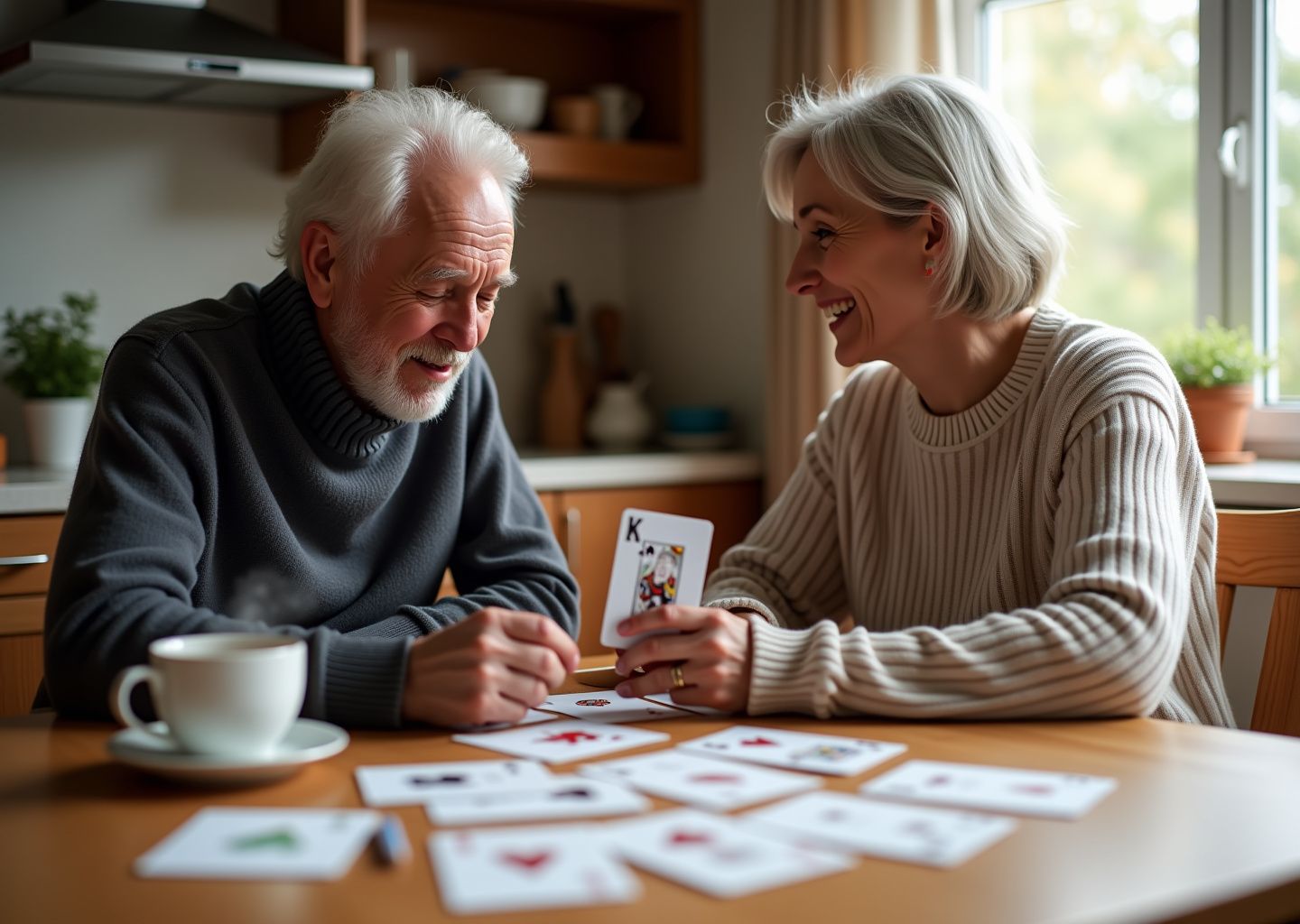
Card games can be an engaging, low-cost way to support language recovery, memory, attention, and social connection after aphasia. This article explores why card play helps cognitive function, practical adaptive games and step-by-step activity ideas for caregivers and people with aphasia, an FAQ about safety and pacing, and clear takeaways to keep practice meaningful at home.
Why card games help cognition and communication after aphasia
A simple deck of cards can feel like a lifeline after a stroke or brain injury. It’s more than just a way to pass the time; it’s a powerful, accessible tool for rebuilding cognitive and communication skills. The magic of card games lies in their ability to engage multiple brain functions at once, creating a rich environment for recovery that is both fun and functional. Unlike repetitive drills, a game provides context, motivation, and a natural reason to communicate, which is exactly what the brain needs to forge new pathways.
At its core, every card game is a comprehensive brain workout. Consider the basic demands of a game like Go Fish. You must pay attention to whose turn it is, what cards have been asked for, and what’s in your own hand. This targets sustained and selective attention. You also rely on working memory to hold onto information that is constantly changing, such as remembering that your opponent just asked for a Queen. This mental juggling is crucial for everyday tasks like following conversations or multi-step directions. More strategic games like Hearts or Rummy layer on executive functions, requiring you to plan moves, adapt your strategy, and inhibit impulsive plays. These are the same skills needed to manage daily schedules or solve problems at home.
For someone with aphasia, the most significant benefit is how games naturally target language. The simple act of asking, “Do you have a seven?” is a direct exercise in lexical retrieval (finding the word “seven”) and sentence production. The other player must then use their auditory comprehension to understand the question and formulate a response. This entire exchange is a miniature lesson in pragmatic conversation, reinforcing the rhythm of turn-taking, asking, and answering. These are typical therapy goals wrapped in a playful package. This repetitive, meaningful practice is the engine of neuroplasticity. The brain learns best through doing, and when an activity is engaging and socially rewarding, it strengthens the neural connections for those skills more effectively than isolated exercises.
Recent research trends support this integrated approach. The concept of cognitive stimulation, highlighted in studies showing that regular participation in games like cards is associated with better overall cognitive function, confirms that keeping the brain active is protective. A 2022 study found that older adults who played cards or mahjong at least weekly had significantly higher scores in attention, calculation, and language domains compared to non-players. Furthermore, the power of socially engaged tasks cannot be overstated. Research from Purdue University on the card game Hearts found that participants who played in a social group showed the most significant cognitive gains, particularly in verbal processing, compared to those who played solo. The social element adds a layer of communication demand and emotional connection that enhances learning.
Even the way we learn from mistakes in a game is therapeutic. While errorless learning, where a person is prevented from making a mistake, is helpful for building confidence with severe impairments, some research suggests errorful learning can be more powerful for others. In a game, making a mistake, realizing it, and correcting it for the next turn helps solidify memory and retrieval pathways more robustly than simply being given the right answer every time.
To make this work at home, it’s important to be realistic and structured. Start with short sessions, perhaps 15 to 20 minutes, three to five times a week, to avoid fatigue. As stamina improves, you can extend the duration. The key is consistency. Progress can be measured not just by who wins, but by setting simple, measurable goals. For someone with severe aphasia, the goal might be to correctly point to a requested card three times per session. For someone with milder challenges, a goal could be to name ten different cards without help or to use a new descriptive word functionally during the game. Choosing the right game is also critical. A person with severe aphasia might start with simple picture matching, while someone with moderate aphasia could handle a modified version of Go Fish. Those with mild aphasia might be ready for games that require more strategy and verbal negotiation.
Here are a few examples of how this looks in real life:
- Robert, who has severe expressive aphasia, plays a matching game with his daughter every morning with coffee. They use large, laminated cards with pictures of his favorite things: his dog, his garden, and his favorite foods. The goal isn’t speaking, but successful matching. After two weeks, Robert begins to consistently smile and point to the picture of his dog when his daughter names it, a small but huge step in responsive communication.
- Maria, who has moderate word-finding difficulties, plays a simplified version of Uno with her grandson. They focus only on matching colors. Her goal is to name the color of the card she plays. At first, her husband quietly provides the word if she struggles. After a month of playing three times a week, Maria is naming all four colors independently 80% of the time, and her confidence in speaking has visibly grown.
- David, who has mild aphasia and some processing delays, rejoined his weekly poker night with friends. Initially, he asked them to slow down the pace. His personal goal was to follow the sequence of play and manage his hand without needing prompts. Six weeks later, he not only keeps up but also starts telling jokes between hands, reclaiming a vital part of his social identity.
These examples show that the objective isn’t to become a card shark, but to use the structure of a game to create consistent, motivating opportunities for the brain to heal. By integrating card play into daily routines, families can support speech, memory, and, most importantly, connection in a way that feels less like therapy and more like life.
Practical card games and step by step adaptations for aphasia
Now that we understand *why* card games are a powerful tool, let’s get practical. The goal is to use simple, familiar games to rebuild pathways for communication and thinking. Below is a catalogue of games you can start using today, complete with step-by-step instructions and ways to adapt them for any ability level.
Remember to start with short sessions of 15-20 minutes, 3 to 5 times a week, and build duration as tolerated. This frequency is more effective than one long, tiring session. Watch for signs of fatigue like yawning or frustration, and always end on a positive note.
1. Adapted Go-Fish
Objective
This classic game is fantastic for practicing naming, asking simple questions, and understanding what’s being said (auditory comprehension). It’s a social, turn-based game that encourages interaction.
Materials Needed
A standard deck of playing cards or a set of picture cards with common objects (like animals, foods, or household items). You can print these yourself or buy pre-made decks.
Step-by-Step Instructions
- Deal 4-5 cards to each player. Place the rest of the deck face down as a “fish pond.”
- The caregiver starts by modeling the language. Hold up a card from your hand so the person with aphasia can see it. Let’s say it’s a Queen.
- Caregiver Script: “My turn. [Person’s Name], do you have a… Queen?” (Point to your Queen).
- Use a yes/no scaffold. You can have large-print “YES” and “NO” cards on the table for them to point to. “Do you have a Queen? Yes or no?” (Give a thumbs up for yes, and a gentle head shake for no).
- If they have the card, they give it to you, and you have a pair. If not, you say, “Okay, I’ll Go Fish!” and draw a card.
- For their turn, help them select a card and ask you for it. A written cue card with the phrase “Do you have a ___?” is a great support tool. They can simply point to the card they want.
Difficulty Levels
- Beginner: Use 4-5 pairs of picture cards instead of a full deck. The person with aphasia only needs to respond with a gesture, a head nod, or by pointing to the YES/NO card. The caregiver does all the asking.
- Intermediate: Use 6-10 pairs of cards. The person with aphasia uses the written cue card (“Do you have a ___?”) to initiate their turn, pointing to the card they want.
- Advanced: Use a full suit of playing cards. The person with aphasia attempts to name the card they are asking for. You can provide the first sound as a cue (e.g., “k-k-k” for King).
Measuring Progress
Keep a simple tally of how many times they name a card correctly or how many times they ask a question using their cue card without your prompting. Research on gamified aphasia therapy shows that consistent practice can lead to significant gains in naming trained words.
2. Memory Match
Objective
This game directly targets short-term visual memory, attention, and word retrieval in a very clear, structured way.
Materials Needed
A set of matching cards. Start with 5-6 pairs and add more as skills improve. Personalizing these cards with family photos or pictures of favorite hobbies makes the game more motivating.
Step-by-Step Instructions
- Shuffle the cards and lay them face down in a grid.
- The caregiver goes first to model. Flip over two cards.
- Caregiver Script: “My turn. I’ll flip this one… it’s a dog. Now this one… a tree. Not a match.” Turn them back over in the same spot.
- When a match is made, celebrate it! “A flower! And another flower! A match! I get to keep these.”
- Encourage the person with aphasia to name the card they flip over.
Difficulty Levels
- Beginner: Use just 3-4 pairs and lay them face up. The goal is simply to find and point to the matching pairs. You can name each object as they point.
- Intermediate: Use 6-8 pairs, face down. When they flip a card, offer a choice if they struggle to name it. “Is that a car or a boat?”
- Advanced: Use 10 or more pairs. Encourage them to use their memory to find a match. “You just saw the other boat. Where was it?”
Measuring Progress
Track the number of pairs they can successfully match. You can also time how long it takes to find all the pairs and see if that time decreases over several sessions.
3. Category Sorting
Objective
This activity strengthens executive functions, which are the brain’s management skills. It works on flexible thinking, organization, and reasoning.
Materials Needed
A standard deck of playing cards or a collection of picture cards from different categories (e.g., animals, food, clothing).
Step-by-Step Instructions
- Start with a simple rule. Place two “header” cards on the table, like a red card and a black card.
- Caregiver Script: “Let’s sort these cards. All the red cards go here.” (Point to the red header). “All the black cards go here.” (Point to the black header).
- Hand them one card at a time and let them place it in the correct pile. Provide gentle physical guidance if needed.
- Once they master one rule, mix the cards up and introduce a new one, like sorting by suit (hearts, spades) or by category (animals vs. food).
Difficulty Levels
- Beginner: Sort by a single, obvious feature like color. Use only 10-12 cards to avoid overwhelming them.
- Intermediate: Sort by a more complex feature, like suits or categories. Use about half the deck.
- Advanced: Introduce a rule that requires more abstract thinking, like sorting playing cards into “face cards” and “number cards,” or sorting picture cards into “things you find in a kitchen” and “things you find in a garage.”
Measuring Progress
Note how many cards they can sort correctly before needing a cue. You can also track how many different sorting rules they can follow in one session.
4. Story Sequencing
Objective
To improve logical thinking and narrative skills. This helps in understanding and telling stories, which is a huge part of daily conversation.
Materials Needed
Sets of 3-5 cards that show a simple sequence of events (e.g., making a sandwich, getting dressed). These are often called “sequencing cards” and can be found online.
Step-by-Step Instructions
- Lay out 3 cards from a sequence in a mixed-up order.
- Caregiver Script: “Let’s put this story in order. Look at the pictures. What happens first?”
- Help them identify the first step. “Right, first you get out the bread.” Place that card on the left.
- “What happens next?” Continue until the story is complete.
Difficulty Levels
- Beginner: Use a very simple 2-card sequence (e.g., a dirty shirt, a clean shirt). Ask them to point to what comes first.
- Intermediate: Use a 3-4 card sequence. After ordering the cards, ask a simple “what” question about each picture (“What is she doing here?”).
- Advanced: Use a 5+ card sequence. After they order the cards, encourage them to tell the story using connecting words like “first,” “then,” and “last.”
Measuring Progress
Track the number of steps in a sequence they can order correctly. Also, note any spontaneous words or sentences they use to describe the story.
5. Adapted UNO
Objective
A fun way to work on color and number recognition, attention, and turn-taking. The bright colors and clear format are very accessible.
Materials Needed
A deck of UNO cards. Large-print or giant versions are excellent for visual or physical challenges.
Step-by-Step Instructions
- Simplify the rules. At first, ignore the special cards (Skip, Reverse, Wild). The only goal is to match the color or number of the top card on the pile.
- Caregiver Script: “The card is a yellow 5. I need a yellow card or a 5. I have a yellow 2. Your turn.”
- Help them scan their cards. “Look, the card is yellow. Do you have any yellow cards?”
Difficulty Levels
- Beginner: Match by color only. Ignore the numbers completely.
- Intermediate: Match by color OR number. Introduce one simple special card, like the Draw Two.
- Advanced: Play with the standard rules, including all special cards.
Measuring Progress
Count the number of turns they take correctly without any help. Celebrate every successful play!
6. Personalized Photo “Who’s Who?”
Objective
To strengthen the retrieval of personally important names and memories, which directly supports social connection and identity.
Materials Needed
Photos of family, friends, pets, or favorite places. You can use single photos or print duplicates to play a matching game.
Step-by-Step Instructions
- Hold up one photo at a time.
- Caregiver Script: “Who is this?” Give them plenty of time to respond.
- If they need help, provide a choice. “Is this your sister, Jane, or your daughter, Mary?”
- Connect the photo to a memory. “This is Jane. We had so much fun at her birthday party last year.”
Difficulty Levels
- Beginner: Use the photos as matching pairs, playing Memory face up. The goal is just to match the faces.
- Intermediate: Ask “Who is this?” and provide a written choice of two names on a small whiteboard.
- Advanced: Ask them to name the person and share one thing about them (“That’s my grandson, Tom. He plays baseball.”).
Measuring Progress
Keep a list of the photos used and check off which names they can recall independently. More importantly, note any smiles, laughs, or shared memories that come up during the game. That’s the real win.
Frequently Asked Questions about using card games after aphasia
Diving into card games is exciting, but it’s natural to have questions. You want to make sure you’re helping, not hindering. This section addresses the most common concerns families and therapists have when starting with card games for home practice. The goal is to give you clear, actionable answers so you can start playing with confidence.
Which card games are safest and simplest to start with?
Start with games that have a single, clear objective and rely heavily on visuals. Simple matching games like Memory or basic sorting tasks (e.g., sorting cards by color or suit) are excellent entry points. They minimize language demands while still engaging attention and memory. A simplified version of Go-Fish, using picture cards instead of numbers, is also a great choice. The key is to build confidence with early success.
- Practical Tip: Begin with a very small set of cards, perhaps just three or four matching pairs for a game of Memory. The focus should be on understanding the turn-taking and the game’s goal, not on winning.
- Warning Sign: If the person with aphasia seems consistently confused about the rules after a few gentle explanations, the game is likely too complex for now. It’s better to switch to a simpler activity than to cause frustration.
- Quick Checklist:
- Does the game have one simple goal (e.g., find a match)?
- Can we play it with just a few cards to start?
- Does it depend more on pictures than on complex rules or language?
How often and how long should we play?
Consistency beats intensity. Short, frequent sessions are more effective than long, infrequent ones. While research shows benefits from as little as one hour of social card play per week, the ideal schedule is progressive. Start with shorter sessions of 15-20 minutes, 3 to 5 times a week, and gradually increase the duration as stamina improves. The weekly template in the “Key Takeaways” section provides a structured plan for this. The most important rule is to watch for signs of cognitive fatigue and always end on a positive note.
- Practical Tip: Try to schedule game time during the person’s peak energy period, maybe mid-morning or after a rest. Tying it to an existing routine, like after a cup of coffee, can help make it a regular habit.
- Warning Sign: Watch for signs of tiredness, such as increased yawning, a higher rate of errors, or visible irritability. It is always better to end a session on a positive note than to push through fatigue.
- Example Script: “Let’s play a few rounds of Uno. We can play for about 20 minutes, and then we’ll take a break for a snack.”
Can card games worsen frustration, and how do I manage it?
Yes, any activity that challenges our abilities can lead to frustration. The goal is to create a supportive environment where success is the most likely outcome. Start with an “errorless” approach, providing enough cues and support to guide the person to the right answer. This builds positive momentum and reinforces learning pathways.
- Practical Tip: Always praise the effort, not just the outcome. If you see frustration building, immediately simplify the task or switch to a different, more familiar activity. Your calm and encouraging presence is the most important tool.
- Warning Sign: Three or more incorrect attempts in a row, pushing the cards away, or becoming quiet and withdrawn are clear signals that the current challenge is too high.
- Example Script: (If they struggle to find a word) “You’re thinking so hard, I can see it. That was a great try. Let’s look at this one together.” Or, “You know what? This game is getting a bit tricky. Let’s put it away and look at those family photos you love.”
How can I tell if the games are actually helping?
Progress after a brain injury is often a game of inches, not miles. Measure success in small, concrete steps. Tracking these small wins is crucial for motivation and for understanding what’s working. Studies have documented measurable gains, such as a 14% increase in naming accuracy over several weeks of game-based therapy.
- Practical Tip: Keep a simple log in a notebook. Note the date, the game played, and one or two specific observations. This creates a record of progress that might otherwise be missed day-to-day.
- Tracking Checklist:
- Date and duration of the session.
- Number of successful actions (e.g., “Named 4 out of 10 picture cards without help”).
- Level of assistance needed (e.g., “Needed a gesture cue for ‘apple'”).
- A brief note on engagement (e.g., “Seemed engaged and smiled during the game”).
How do we adapt games for physical impairments like one-handed play?
Physical limitations should not prevent participation. Simple tools and modifications can make almost any card game accessible.
- Practical Tips:
- For one-handed play, a plastic or wooden card holder is a game-changer. You can buy one online or easily make one by cutting a slit in a small cardboard box.
- For visual challenges, use large-print or jumbo-sized playing cards.
- To make cards easier to pick up from a table, use a deck with a plastic coating or place them on a felt mat. The caregiver can manage all shuffling and dealing.
How can I involve the whole family while maintaining dignity?
The key is to frame game time as a shared social activity, not as “therapy.” The person with aphasia should be a respected player, not a patient. Empower them with choices and ensure the focus is on connection and fun.
- Practical Tip: Let the person with aphasia choose the game or decide who deals the cards. During the game, make eye contact and model patient, respectful turn-taking. Avoid correcting every mistake and celebrate moments of shared laughter.
- Warning Sign: If the person becomes passive or seems to be just “going through the motions,” they may feel patronized. Ensure they have an active and meaningful role in the game.
- Example Script: Instead of a testing tone (“What card is this?”), use an inclusive, natural one (“It’s your turn to play. What do you have for us?”).
When should we stop or change a game if there’s no progress?
A plateau is a normal part of recovery. However, if you’ve been playing a game consistently for about four weeks and your tracking log shows no small improvements, it may be time for a change. The game might be too hard, too easy, or simply not engaging enough.
- Practical Tip: Before abandoning a game, try modifying it. Can you use fewer cards? Can you change the goal slightly? If modifications don’t help, switch to a new game that targets a similar skill in a different format. Discussing the plateau with your SLP can provide fresh ideas.
How do we balance structured practice with just having fun?
A healthy mix is essential. A good rule of thumb is a 70/30 split. Spend about 70% of your game time with a gentle therapeutic focus, like practicing specific words or taking turns asking questions. The other 30% should be for pure social enjoyment, where the rules are relaxed and the goal is simply to connect and have fun.
Are expensive commercial “brain games” worth the cost?
Not always. The most effective tools are often the simplest. A standard $5 deck of playing cards or a set of homemade cards with family photos can be far more powerful than a costly commercial game. The best game is one that is motivating, adaptable, and used consistently. If a commercial game like large-print Uno meets those criteria, it can be a great investment. But don’t feel pressured to buy expensive products.
How do I coordinate our home practice with our speech-language pathologist (SLP)?
Collaboration is key. Your SLP is an expert who can guide your efforts and integrate your home practice into the overall therapy plan. Share your simple tracking log with them during appointments. This provides them with invaluable real-world data on what’s working and where challenges remain.
- Practical Tip: Bring your log and maybe even the card game itself to your next SLP session. This allows the therapist to see the activity in action and offer specific suggestions for modifications.
- Example Script for your SLP: “We’ve been playing this matching game at home. Here’s my log showing how it’s gone for the last two weeks. I’ve noticed she’s getting faster at finding pairs. What do you think would be a good next step to build on this?”
Key takeaways and next steps for sustained home practice
You’ve learned how card games can be powerful tools in life after aphasia. They are more than just a way to pass the time; they are a bridge to reconnecting language, sharpening memory, and strengthening bonds with loved ones. The key is turning this knowledge into a consistent, supportive home practice.
The journey of recovery is built on small, steady steps. Card games offer a structured yet enjoyable way to practice cognitive skills. Studies show that regular, social game play can lead to measurable improvements in areas like verbal processing and attention. A study on the game Hearts, for example, found that playing in a social group led to significant gains in verbal fluency. The goal is not to master every game, but to use them as a vehicle for meaningful communication and cognitive exercise.
Your Action Plan Starts Now
Moving from reading to doing is the most important step. Here is a clear plan to integrate card games into your routine immediately.
Top Three Recommended Games
Start with games that are simple to learn and easy to adapt. This helps build confidence and reduces initial frustration. These three are excellent starting points.
- Go-Fish. This game is a fantastic tool for practicing naming and asking questions. This type of structured, repetitive practice, common in game-based therapy, has been shown to lead to measurable improvements in naming ability. Adaptation for immediate use: Start with a small set of picture cards (10 pairs) featuring familiar objects, family members, or favorite foods. The person with aphasia can ask for a card by naming it, pointing, or using a “yes/no” response to a question like, “Do you have the apple?”
- Memory (or Concentration). This game directly targets short-term visual memory and attention. Lay cards face down and take turns flipping two at a time to find a match. Adaptation for immediate use: Use a 12-card set (6 pairs) to begin. As you flip a card, say its name out loud. This adds a layer of language practice. Celebrate finding a match to keep the mood light and positive.
- Hearts. For those ready for more complexity, Hearts is excellent for executive functions like planning, strategy, and working memory. The social interaction required is also a major benefit. Adaptation for immediate use: Play with open hands at first to discuss strategy together. Use a written “cheat sheet” that lists the card ranks and suit rules. The focus should be on participation and understanding the flow of the game, not on winning.
A Weekly Template for Sustained Practice
Consistency is more important than intensity. A regular schedule helps build habits and allows the brain to adapt and form new connections. This template can be adjusted based on energy levels and progress.
Weeks 1–4: Building the Foundation
- Frequency: 3 sessions per week.
- Duration: 15–20 minutes per session.
- Focus: Play one simple game like Go-Fish or Memory. The goal is to learn the rules, establish a routine, and experience success. Keep it positive and low-pressure.
Weeks 5–8: Increasing the Challenge
- Frequency: 4 sessions per week.
- Duration: 25–30 minutes per session.
- Focus: Introduce a second game or a more complex version of the first one. For Memory, increase the number of pairs. For Go-Fish, use a full suit of cards. The aim is to build cognitive endurance.
Weeks 9–12: Expanding Skills
- Frequency: 4–5 sessions per week.
- Duration: 30–40 minutes per session.
- Focus: Introduce a strategy game like Hearts or continue to increase the complexity of existing games. Encourage more spontaneous conversation during gameplay. The goal is to apply skills in a more dynamic setting.
How to Track Improvement
Tracking progress provides motivation and helps you see what’s working. It doesn’t need to be complicated. A simple notebook or a chart on the fridge is perfect. This information is also incredibly valuable to share with a speech-language pathologist (SLP).
Sample Tracking Chart Items
Create a simple table to log progress after each week.
| Week | Game(s) Played | Number of Words Named (Go-Fish) | Pairs Matched in 5 Min (Memory) | Notes (e.g., energy level, new phrases used, moments of fun) |
|---|---|---|---|---|
| 1 | Go-Fish (10 pairs) | 5 | N/A | Felt tired after 15 mins but enjoyed matching family photos. |
| 2 | Go-Fish, Memory | 8 | 2 | Asked “your turn?” independently today. |
Working Together for Meaningful Progress
Your home practice is most effective when it’s part of a team effort.
Collaborating with Your Speech-Language Pathologist
Your SLP is your most important partner. Share your tracking chart with them regularly. They can use this data to adjust therapy goals and provide specific card sets or game adaptations that target your unique needs. Ask them to help set a baseline, perhaps using a tool like the Boston Naming Test, so you have a clear starting point to measure against. A monthly check-in about your home practice can ensure it aligns with your formal therapy.
Adjusting Goals and Keeping Play Meaningful
Progress is rarely a straight line. If you hit a plateau or a game becomes too frustrating, it’s a sign to adapt, not to stop. If naming becomes difficult, switch the goal to sorting cards by color or suit to work on categorization. If a game feels stale, create your own cards with pictures of hobbies or recent events. The goal is connection and engagement. If you are laughing and communicating, you are succeeding.
A Final Word of Encouragement
For caregivers and partners, your role is to be a patient and encouraging coach. Your calm presence is the most important part of the game. Celebrate the effort, not just the outcome. A “great try” is just as valuable as a correct answer. Notice signs of fatigue or frustration and be ready to suggest a break or switch activities.
For the person with aphasia, remember that every attempt is a victory. This process is about gently rebuilding pathways in your brain. Some days will be harder than others. Be kind to yourself. The purpose of these games is not to test you, but to give you a playful space to heal and reconnect. The shared moments of laughter, the quiet focus of finding a match, the simple act of taking a turn, these are the real wins. They are the building blocks of recovery and a renewed sense of connection for life.
References
- Association of Playing Cards or Mahjong with Cognitive Function in … — The findings suggest that there is an association between participation in cards or mahjong and cognitive function in the population of Chinese older adults.
- [PDF] THE EFFECTS OF CARD PLAYING ON COGNITION – Purdue e-Pubs — One study utilized a measure of general cognitive functioning and found an increase after training (Reijnders et al., 2013). Reijnders and colleagues (2013) …
- A gamified aphasia intervention: playing naming and scenario … — Playing games where people with aphasia can support each other and repeatedly practise speech in everyday life scenarios is a promising way to further aphasia …
- The effect of the leisure activities based on chess and cards for … – NIH — This paper describes the methodology of a cluster RCT designed to determine the effect of chess and cards leisure activities on the cognitive function of the …
- [PDF] Game-based Training of Cognitive Functions: An Exploratory Study … — We developed a set of games to train multiple cognitive functions of seniors, considering that their level of digital literacy can vary greatly. A participatory …
- Game-Based Group Therapy for People With Aphasia: A Feasibility … — Game-based group therapy is feasible, and participants reported high satisfaction. We found the games to be easily implemented and adaptable and that training …
- Neuroscientists and Game Designers Play Well Together — Neuroscientists and game designers play well together. Researchers cross intellectual boundaries for better data, better games and real impact.
- [PDF] Designing Game-Based Rehabilitation Experiences for People with … — 2.1 Aphasia and Game-based Therapy. Recent research points to games as a promising pathway for aphasia therapy given their low price- point and potential for …
- [PDF] Xie 1 Games to Gains: Exploring Play as Therapy for Aphasia … — This research incorporates games in speech therapy to improve outcomes among adults with post-stroke aphasia. Aphasia is a language disorder …
- Playing Games Associated with Higher Late-Life Cognitive Function — At ages 70 and 76, about one-third of the sample (33%) said that they played games every day or nearly every day. The researchers found that …
Legal Disclaimers & Brand Notices
The content provided in this article is for informational and educational purposes only. It is not intended to be a substitute for professional medical advice, diagnosis, or treatment from a qualified healthcare provider, such as a physician or a licensed Speech-Language Pathologist (SLP).
Always seek the advice of your physician or other qualified health provider with any questions you may have regarding a medical condition, treatment plan, or recovery protocol, especially concerning aphasia or post-stroke rehabilitation. Never disregard professional medical advice or delay in seeking it because of something you have read in this article.
All product names, logos, and brands mentioned herein are the property of their respective owners.